

What are dashboard experience templates?
A dashboard experience template controls the visual layout and widget set a white-label customer sees when they open their portal. Each template is purpose-built for a specific type of AI product, so customers who signed up for your AI Receptionist get a call-centric dashboard, while customers using the AI Gateway see an API-usage dashboard — all automatically, with no manual setup needed. This is a separate axis from the Dashboard Mode (Standard / Agency + Infra / Infra / JARVIS) that governs which sidebar menus are visible. The template only affects the dashboard body and chrome — menus, billing, and features are unchanged. The six templates appear as selectable cards in the Dashboard Experience (Beta) section of any experience’s settings page (One-Click Experiences → [experience] → Settings):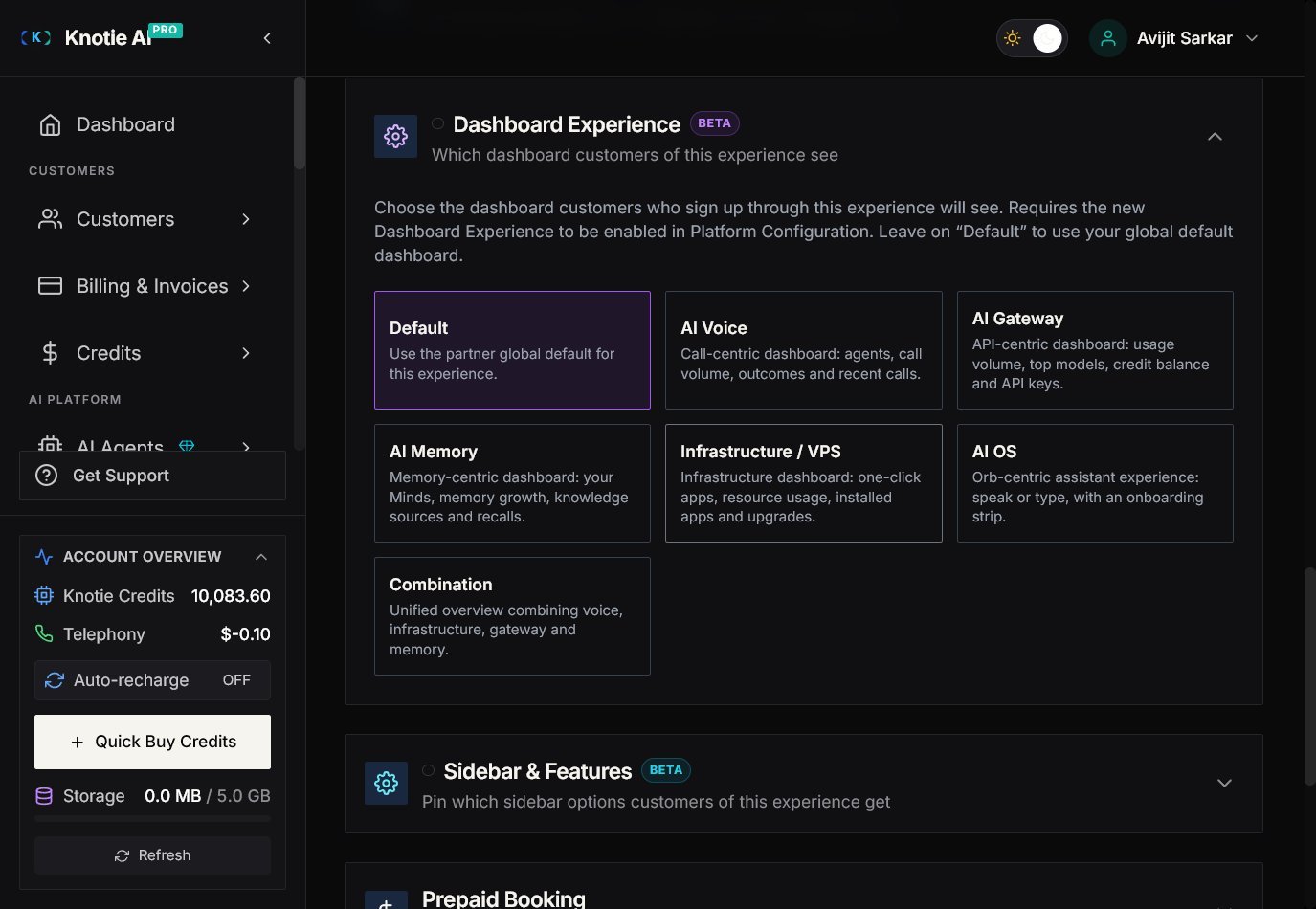
The six templates
How a customer gets a template
Every customer is assigned exactly one template automatically. The system looks at the following, in order, and uses the first one that applies:- A specific template set for that individual customer (arranged through support).
- A template you’ve chosen for that experience, in Experience Settings → Customer Dashboard.
- The built-in default for the experience type (see below).
- Your account-wide default, set in Settings → Whitelabel → Default dashboard experience.
- A fallback based on the Dashboard Mode — Standard shows AI Voice, Agency + Infra shows Combination, Infrastructure shows Infrastructure / VPS, and JARVIS shows AI OS.
If a template value is ever missing or unrecognized, it’s skipped and the system moves to the next option — so a customer always gets a working dashboard.
Built-in defaults by experience type
You can override any of these per experience in Experience Settings → Customer Dashboard.
Turning it on
The new dashboards are opt-in, and they’re off by default — nothing changes for your customers until you switch them on.- Off: every customer keeps the current dashboard. No action needed.
- On: new customers signing up through an experience that has a template (either one you chose or its built-in default) get the new branded dashboard automatically.
- Existing customers stay on their current dashboard until a later update moves them over.
Auto-branding
All six templates automatically apply your brand colors and fonts — your customers get a dashboard that looks like yours the moment they log in, with no extra work needed. Here’s what gets branded:- Your brand colors: Your primary and secondary brand colors automatically appear as accent colors throughout the dashboard. If you haven’t set custom colors, we use a professional indigo as the default.
- Dashboard appearance: All dashboards use a dark, modern look. Light mode is coming soon.
- Your brand font: If you’ve configured a brand font, it appears on the dashboard. Otherwise, we use a clean, professional default.
- Language support: For Arabic, Hebrew, Farsi, and Urdu customers, the dashboard automatically flips to right-to-left layout.
Related pages
- Per-Experience Customer Dashboards — step-by-step: how to enable V2, configure templates per experience, and set the global default
- Whitelabel Settings — where the global default template toggle lives
- Platform Configuration — Dashboard Mode (sidebar menu defaults) — separate from templates
- AI Experiences — enable and manage your experiences